


Generations theory says where we are right now as a country—a Fourth Turning1 —is predictably complete and total chaos. We know this from research on six centuries of history, as those who last experienced it in the US—in the 1920s and 30s—are largely no longer here to tell the tale of the chaos, but also, very importantly, the reassuring story of the national rejuvenation of the First Turning that followed.
While it’s hard to see it in the middle of it, Fourth Turnings are critical for revitalization of systems developed at a very different time almost a century ago that are simply no longer working for us as a country anymore. Healthcare is squarely on that list, and women’s healthcare—basically ignored in research until just the last few years—certainly is.
Based on those six centuries of research, authors Strauss and Howe said back in 1997 (see footnote) that we would be in the midst of our Fourth Turning by 2025. They noted that Fourth Turnings “shake a society to its roots, transform institutions, redirect social purpose, and mark people and generations for life.”
And it is.
History also says what will eventually work is finding community together about the problems we face: that it will take all of us, together, leveraging those new communities to get to the next stage, our First Turning, a national high parallel to what happened in the US after World War II.
Two Substackers I very much admire posted today on two seemingly different but absolutely related healthcare issues
These may look like completely different posts, but from a generations theory perspective, they are very much connected. Both deal with systems that are just plain not working: healthcare generally, and women’s healthcare in particular. Both of these posts are well worth reading and considering; I ask you to join me in doing that.
Because how all this turns out is up to us—and women, arguably the peace makers, have a more important role this time around than ever before.
Click for A Meeting with the MAHA Grassroots
Katelyn Jetelina, PhD (Your Local Epidemiologist) holds a doctorate in epidemiology and a master’s degree in public health. She has readers in 50 states and 126 countries and serves as a consultant for the CDC and multiple other healthcare institutions. More importantly, she speaks a language everyone can understand about what’s going on in US healthcare. In this post, she takes the bull by the horns and meets directly with the MAHA grassroots. She comes away with learnings for all of us who want more than anything to just. move. forward—and how we can do that with empathetic listening and building positively on different experiences of a shared era…finding common ground.
Click for Uncomfortable by Design
Maryann Umoren Selfe, PhD (FemmeHealth Ventures) holds a doctorate from MIT’s Sloan School in conjuction with Business School Lausanne, and is a seasoned investment professional and executive with over two decades of experience in banking and long-term investing. Internationally based, she bridges the oceans on research and investment. Fortunately for us, her passion is women’s health, closing the funding gap that has held back research and innovation, and building communities where impact and women’s health innovation meet. This post—about how speculums and pap smears haven’t changed in 80 years—rang bells for thousands of women, generating over 65,000 views, 3,700 likes, and nearly 500 comments and reposts of stories of pain, delays, and outcomes no one—female or male—should have to ever put up with in our theoretically ‘best healthcare in the world.’
Whether or not we like the way change is happening right now…
…the bottom line is that this is the time history said we would have to dig out of century-old systems that are no longer working for so many of us. And the truth remains that only by finding community—together, not apart—can we reinvent where we all need to be after this.
Thank you for being active in these Substack communities and at home, work, and in your local communities. We can do this, and we will—but we can only achieve that together. How it turns out is up to us.
In my other life, I speak nationally on generations theory—the well-document social and economic research, not the pop psychology/meme version marketers deploy. Over six centuries of Anglo-American history, there are consistently recurring cycles of innovation, growth, stagnation, and revitalization. If you think about it, those are the same cycles businesses go through, so it’s no surprise governments face them as well. For more about the Fourth Turning, see Strauss, William and Howe, Neil, The Fourth Turning: What the cycles of history tell us about America’s next rendezvous with destiny (1997) and Howe, Neil, The Fourth Turning is Here: What the seasons of history tell us about how and when this crises will end (2023).
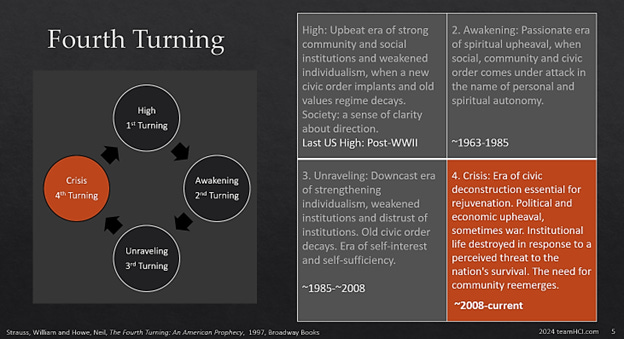
Each of the generations plays a different role during Fourth Turnings, and both Dr. Jetelina and Dr. Selfe are in the younger generations that will lead us out of this mess—Gen X—or Millennials, the civilization builders of the new First Turning. Boomers? Generations theory long ago predicted we’d bring on this mess—but again, remember, generations theory also says this is all a predictable and necessary cycle.