


Women make north of 70% of all purchasing decisions and are the default Chief Medical Officers for our families, workplaces and communities. While the changes in DC may not affect you today, eventually these changes will touch all of us. Now’s a good time to start thinking ahead, a lot faster than we have been.
Last week in DC
Last Tuesday, February 11, President Trump signed an executive order authorizing a significant reduction in the size of the government, instructing heads of federal departments and agencies to make "large-scale reductions in force." By Thursday, Feb. 13, the new Department of Government Efficiency (DOGE), led by Elon Musk, was active at 22 government agencies, including nearly every cabinet-level department, as well as FEMA and NOAA.
More than 10,000 federal workers across multiple agencies were fired in first-wave reductions in the government workforce in two days.
Another 1,000 were laid off at the already-understaffed VA, including suicide crisis line staff at a time suicide is a terrible and tragic problem in the military.
By Friday, the Energy Department was struggling to rehire 300 to 400 fired employees (of 1,300 total) mistakenly let go because DOGE didn’t realize they were responsible for nuclear bomb safety.
At the one department that brings in revenues and issues our tax refunds—the IRS—thousands were being laid off in the middle of the tax season.
Coupled with about 75,000 workers who took earlier buyouts, the job cuts amount to nearly 4% of the federal government's 2.3 million workers. Which doesn’t sound like much…unless, of course, it’s you.
Firings focused on “probationary” employees, who were given a month’s pay. These are not your typical youngsters who can easily find another job. Many of these are scientists who trained for a decade, often with a huge educational cost burden and families of their own. These are highly-specialized, non-transferable skills. Others include full-time employees of other government agencies who transferred to a different government department; new transfers and some promotions are automatically “probationary” employees. Some are personally committed to public service, eschewing the for-profit side of life.
In addition, an unspecified number of CDC and HHS contract workers were informed last week their jobs had been terminated, including dozens at the NIH Vaccine Research Center, where you’d think there is likely a focus on bird flu. At the already-understaffed USDA lab responsible for managing all bird flu testing, with probationary staff gone, notices were sent to testing labs that results will be slower.
Why it’s happening this way, this fast
Republicans campaigned on cost savings and they had four years to plan this time. DC usually moves at an elderly snail’s pace, and the WH was able to move much faster than the denizens of DC—or, apparently, the world—expected. Elon Musk, heading up DOGE (and its immediately-hacked website) originally promised $2 trillion in savings on the $7.5 trillion annual budget, about 30% of total federal government spending. Rumors abound Musk’s ambitions have been scaled back to a glorified IT consultant, bent on automating systems and slashing jobs, rather than meaningfully reducing the size of government. However, there’s reason to doubt Musk spent more than a quarter billion dollars getting Trump elected to sit in a basement IT office.
Whatever DOGE ends up accomplishing, the promise of $2 trillion in savings looks back-of-the-envelope. Another better-known “nuke government” proponent, David Stockman, attempted to remake government during the Reagan administration. He recently shared—with far greater detail—what he thinks DOGE can accomplish. In his analysis, Stockman proposes completely eliminating 16 federal agencies, including the FBI, the Drug Enforcement Administration and the Bureau of Alcohol, Tobacco, Firearms and Explosives. That would get rid of 535,000 federal jobs and close dozens of buildings in the process, and would save a total of $400 billion, 20% of what Musk promised.
On the path to what is essentially a corporate turn-around, there are two ways to eliminate jobs: cautiously, or not, and with care for those affected, or not. Like Musk’s Twitter take-over that eventually eliminated 80% of their workforce, this is the “not” approach. The premise of his ‘slash now, fix later’ approach is “if nothing falls apart, it wasn’t needed, and if it falls apart, we’ll fix it then.” One suspects “if we don’t do it, the states will have to do it” is buried in there as well.
The tsunami is designed to get the pain over quickly while Republicans have control of Congress, doubly important since a president’s party often doesn’t do well in midterm elections. The hope is that all well be well by November 2026 and everyone will forget today’s pain. It might work if you don’t count history, which holds a very different message.
For tech bros who live in the now and prize disruption, it’s the only way to fly. For those who understand the deep differences between the tech business and governing, it’s alarming. It’s also designed to make sure people know there’s a new sheriff in town, satisfy those hungry for retribution, and to elicit fear and submission.
Without getting into the probable effects on every facet of our lives from unemployment rates to recession threats, let’s look at why what’s happening is important to our health and lives as women.
What it all means to us as women at home, at work, and in the community
On health alone, whether you’re a data geek like me, or simply want “do this/don’t do that” info when your child (or the grand you’re sitting) runs a temp of 104, that information comes out of some department of Health and Human Services (HHS), now directed by Robert F. Kennedy, Jr. Yes, you can find a whole lot on the Internet…from influencers who got a C- in everything in school except recess to highly qualified experts. Keep in mind the latter depend on data; experts don’t dream up fixes. If the data isn’t there, experts are reduced to guesses, and the older or more incomplete the data, the worse the guesses.
At the end of the day, women make health and life decision, and we have to live with them. If our unvaccinated kids get through measles in a couple weeks without major problems and now have life immunity, it’s all good. If our youngest dies of a complication from measles like encephalitis, it’s not—and we get to live with that decision, which might have been made more casually than we’d like now that we know more. Like everything else in life, decisions are a trade-off.
But what happens with the data is too old—or missing—to make a decision? We’ve grown used to having a world of science and analysis at our fingertips, distilled for our immediate use. Most of the time we don’t even know where the data originated, so we don’t miss it until it’s gone. And that’s what’s been quietly happening for two weeks now—way too early for us to yet feel the loss.
There’s another practical problem as well with DOGE’s efforts. The amount of cuts being promised can really only come from two places: defense or entitlements like Medicaid, Medicare and Social Security. No other budgets are even close to large enough to get the promised savings. [View an infographic of the FY23 Federal Budget here.]

DOGE hasn’t visited the Pentagon yet. The DOD budget is $886 billion, almost a trillion on its own. There’s enough concern there about potential havoc from young engineers that the DOD has started looking at cuts already. On paper, going after entitlements is obvious, but they’re called entitlements not to disparage those who receive the benefits, but because entitlements are guaranteed by law that only Congress can change. Which is why there are already seismic rumbles in Congress about the new budget, expected to attack key safety net programs like Medicaid and food assistance to pay for Trump’s massive domestic agenda, including more tax cuts.
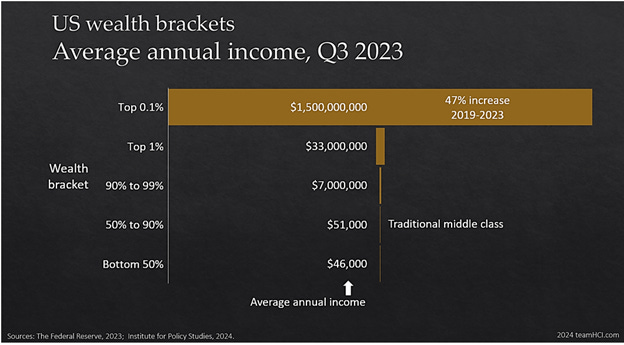
I’m not going to spend time on the latter, other than saying I highly recommend you do. Here’s a link that might help, and see the footnotes for Federal Reserve data1 on 2023 annual average incomes. Pay particular attention to the mere $5000 difference between the bottom 50% of the population and the 50% to 90% that used to be our Middle Class. And then look carefully at what happened to the Top 0.1% after Trump’s last tax cut. Finally, here’s a hint: On a percentage basis, we had a wealth gap almost this large after WWII, and it wasn’t a tax cut that got us out of that then, either.
What can we do now? What will help get through this?
Pay attention. Yes, it’s a firehose, and it’s designed that way to confuse, distract, and keep moving forward very quickly. But these are just the preliminary shots; what’s coming next will reach much deeper. Do not go unconscious now.
Consider what government does that you like—not just what you don’t like. In particular, consider protections and information you enjoy, and where they’re coming from. We grown to expect government protections without actually realizing how they exist. Think about what you do value—and how to preserve it.
Absolutely voice your values and concerns. During massive political upheaval, about the only thing that can break through is constituents. Whether you love what’s happening or hate it, let your representatives know. Find your representative here and your senator here.
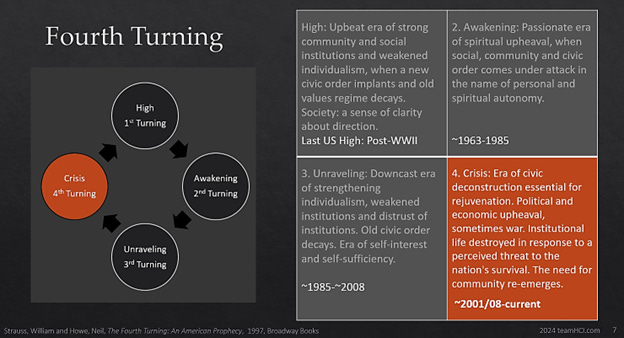
Keep in mind nothing this government—or any other—does will be all bad or all good. Good will come from this, no matter how hard that is to see now; start looking for possibilities. In Generations theory, what we’re going through was completely expected and in fact was predicted 30 years ago to happen by 2025.2 Uncomfortable as it is right now, our institutions and ways of governing were outdated and have worked for many or most of us for years or decades. For instance, I’ll be surprised if you don’t think either the defense budget and/or entitlements are inconsistent with your values and wasting your tax dollars. Or how about mammoth, expensive buildings that are two thirds empty in a digital age?
Don’t expect it to stop or slow down; anticipate it will get worse before it gets better. Think ahead to how more changes might affect you and yours. What can you do now to mitigate those effects?
Elections do count. Whatever the extent of the Republican mandate, they won and dominate at least two branches of government. Start thinking about the 2026 midterms: do you reinforce or fight what’s happening? How will you do that?
Stay centered. If you don’t meditate, now’s a great time to start—there are plenty of great apps. Exercise; take care of yourself. Others depend on you; if you lose it, they will, too. This is a time that women need to stand on our values, and step up and lead at home, at work, and in our communities. I think of the women of Ukraine almost daily; what they’ve done puts my puny concerns to shame.
Seek context. For five centuries of Anglo-American history, our nations have gone through the need to reform and renew our institutions every 80 to 100 years. This isn’t our first rodeo. The last time we went through this was in the 1930s. Check history to see what the causes were then, what happened, and how we made it through. You’ll find striking similarities, and unexpected, positive differences. Remember: you and I—we—drive how this ends.
Where are you right now with all this? What do you hope they’ll change? What do you see as destructive or protective balances this time around? How do your values mesh with events? How is all this affecting you? Your family? Work? Your communities? How are you making your opposition or support known? What are you doing to stay sane? How are you keeping those you love and care for rooted? Comment below—all of us can use all the thoughts and tips we can get right now.
US wealth brackets, average annual income, Q3 ‘23. Source: The Federal Reserve.
The last century of American turnings. See Strauss, William and Howe, Neil, The Fourth Turning: An American Prophecy, 1997.
I see a few new ones in my inbox from you. Looking forward to catching up on them!