

The US was isolationist during much of World War II, but after Pearl Harbor on December 8, 1941 it was all hands on deck. Men went off to war by the millions and women stepped into the civilian and military jobs they left behind.
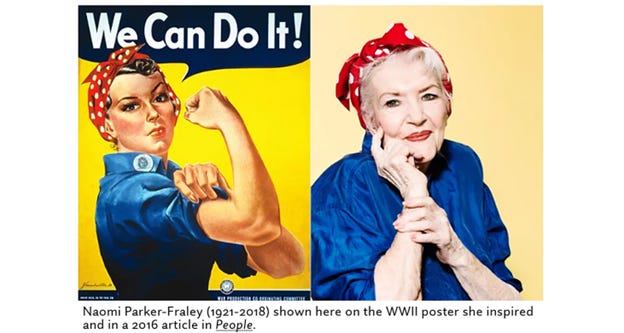
Rosie the Riveter was inspired by real-life Naomi Parker-Fraley, a waitress who joined the war effort and was photographed in a Navy machine shop during World War II. Her photo was used all over America to celebrate women contributing to the war effort; Ms. Parker-Fraley was finally credited 70 years later.1
From secretaries to Rosie in World War II
Before World War II, only 16% of adult women in the US worked outside the home, often prior to marriage.2 They worked in the traditional female-dominated positions of the time—secretaries, store clerks and receptionists—but were otherwise rarely seen in the work force. With the labor force's war-time demands, an estimated six million women started working in fields previously closed to them, proud to serve their country.
The US produced posters and film reels of glamorous women in the workplace to entice women to serve their country as part of the home-front labor force.3 Women suddenly worked in construction and factories, drove trucks, cut lumber, farmed, and built planes, trains and ships. While a few women served in clerical jobs in WWI, nearly 350,000 American women served in uniform in WWII. Over 70,000 women served as military nurses, and the Cadet Nurse Corps was established to address a nursing shortage, training nearly 120,000 nurses. And with a war to cover—and fewer available men to cover it—the media world also presented opportunities to women as journalists, photographers, and broadcasters.
You won’t be surprised to hear the workplace wasn’t real welcoming initially. Women received less pay and some men looked down on them and felt they weren’t up to handling a ‘man’s job.’ They often faced sexual harassment, long hours and dangerous working conditions—the first of us to test tradition in a man’s world.
The resistance was likely far greater for the 6888th Battalion—the first and only all-Black female unit to be deployed overseas during World War II, called up by the Army up out of desperation to manage a backlog in Britain and France of millions of pieces of mail to and from US service members. Imagine mothers not having a clue for months whether their sons were alive or dead—and those same sons, mostly vry young, not getting any mail at all from moms, girl friends, wives or anyone else back home.4 The Army estimated it would take seven months to clear up the backlog; the 6888th did it in three (of course). They weren’t recognized until 2022, finally getting the medal they deserved yesterday...80 years later.
Rosie gave birth to the Boomer women who shattered the glass ceiling
Through the course of the war, the overall share of women in the U.S. workforce jumped to 37 percent, but the real impact was on the daughters of those wartime women, Boomers, born from about 1946 to 1964 at what was becoming the end of the Industrial Age.
Almost 60% of Boomer women worked outside the home, breaking through barriers younger generations are unable to even imagine. It wasn’t always a pretty transition as we wrote the manual on how to do that; the male role model of the time certainly didn’t apply. (For one thing, we had no wives of our own.) Multiple generations since have smoothed out the wrinkles, starting with Gen X women who navigate life with unprecedented confidence in their own leadership abilities, having had to figure out so much on their own. More than 70% of Millennial women are now in the workplace, and both Millennials and Gen Z have an expectation—not just the Boomer and Gen X hope—of workplace gender neutrality.5
Our Rosie the Riveter Rewards: a subscription sale from May 1 through May 11, Mother’s Day
Celebrate Rosie’s impact on American women and families, and the women who—with absolutely no user manual—pioneered how to have a family and a career. Take a second to thank Rosie—and Naomi Parker-Fraley—in your heart and mind. And, if the time is right for you, consider supporting our focus on women’s health and lives with an annual subscription, half off May 1 through midnight on Mother’s Day, May 11. Either way—free or paid—we love you, and thank you for fulfilling Rosie’s promise every day at home, at work, and in our communities!
Sale subscriber prices: $7.50 for a month, $60 annual, or—goddess bless you!—$125 for Founding Motha! TIA!
The US census from 1940, the year before Pearl Harbor, showed 67,620,850 women 21 years of age or older, and there were about 10,800,000 US women in the workforce at the time.
Read more here about women’s war efforts.
I’ve used the Six Triple Eight for years in my Generations presentations as an example of how different populations experienced WWII and it’s aftermath, as WWII opened up careers for White women—but not Black. The members of the 6888th, stationed overseas in Britain and France, came home to the same ‘opportunities’—maid jobs—they had before they experienced Europe serving our country. My uncle, who was a WWII POW in Germany, never had any idea these women existed and made sure he and his parents received mail from each other during his prison camp internment. President Biden formally recognized the 6888th in 2022, but most of America never heard about them until the new Netflix documentary. And just this week, the Congressional Gold Medal authorized two years ago by President Biden was finally award to the 6888th.
See more here about how different generations view gender in the workplace.