


“Women’s health” sounds so innocent, so pure. Something everyone can support! Who wants unhealthy women, after all? Sick mothers or grandmothers? Not mine! Women’s health forever…right?
For women, “women’s health” is heart disease, cancer, arthritis, menopause, autoimmune disorders, endometriosis, osteoporosis, mental health, diabetes, and, of course, childbirth. Eighty or more years of a woman’s life, during which a year or two are absolutely consumed by pregnancy and birth…but for most women today, that’s it. The other eight decades are focused on parenting, life, and the million other body parts and functions—hers and those she loves—that demand attention.
But for many politicians, the phrase “women’s health” involves only one thing: the uterus. Like Hippocrates 2000 years ago, it all comes down to that weird [AKA not-male] uterus.
Before 1960, the uterus and its reproduction function were pretty much random. From the beginning of time, for many men, whatever went on down there was mysterious and time-delayed enough to allow a full disclaimer.1 But women knew, and in 1960 science gave us the first reliable birth control in the history of the world. Consider that: in the history of the world. Within two years over a million women were on “the pill,” able to fully control their own destinies for the first time, ever.
For many men, from Hippocrates (and Adam before him) to today, this is not necessarily a good thing.
That was then; this is now.
“No American woman should be denied access to family planning because of her economic status.” —President Richard Nixon (R), 1970
In her excellent post, The quiet defunding of care: What Title X tells us about who deserves care, Maryann Selfe of FemmeHealth Ventures cited that quote from Nixon as he signed the Title X bill. Good thing she did. It sure wouldn’t otherwise see the light of day right now.
Maryann comes at women’s health from the financial side, and in the short period of time I’ve ‘substack-known’ her, I’ve learned a lot from her already because of that. Those of us who are seasoned warriors in women’s health were raised on the ‘passion’ side, lacking good financial info at the time. We don’t always view it through contemporary financial lenses of investment and capital. It’s refreshing to see women’s health through her eyes; there’s a lot to be learned. She understands the financial implications of women’s health funding at both a macro level and the very personal micro level of “Where will I go now?”
Title X is the only federal program in the United States dedicated to providing family planning services to low-income individuals, particularly those who have no insurance or are underinsured. It does not fund abortions—just contraception. Last week, HHS announced a “temporarily withholding” of over $65 million in Title X funds committed last year to support rural health centers, mobile care, and Planned Parenthood clinics in underserved communities. On March 31, sixteen grantees received notices telling them funding for 22 of their Title X grants was being “temporarily withheld.” Those grants affect almost a million low income women, and represent nearly a quarter of all Title X grants.
The hold took effect the following day.
“Temporarily withholding” itself is a marvel of political spinspeak. The implication of possible reinstatement holds off mobilization by women, who have proven very capable of showing up for a fight. That temporary hold can then slide forever into obscurity.
The organizations involved can’t pay bills or employees on “temporary.” So “withholding” $65+M in Title X funds works immediately to shut down organizations that depend on that funding. It can take years after funding is approved in DC to get everything in place to open clinic doors. They can be shut overnight.
As Maryann points out, this is a clear message about who controls healthcare for whom. The original Title X bill took years to reach approval. The slow drip of funding withdrawals will affect at-risk women’s healthcare access for years to come.
There were headlines, but no protests and so far no major social media viral activity. The “withholding” was ordered in the midst of ‘Tariff Chaos Week’ and a barrage of other actions. Relentless effective messaging on the Right has made whatever actually happens at Planned Parenthood murky, and after 75 years of hearing about it, the public is exhausted. Boomers—still one out of every five Americans alive—don’t use birth control. Next news cycle, please.
On the surface, it looks as if this is ‘just’ about women and women’s healthcare. But as Maryann points out, it’s also very much about our inability as a nation to figure out whether basic healthcare is a right or a privilege. Given our reluctance to discuss that openly and rationally without instant screaming about socialism, we’ve been deciding it passively, with 60% of the population now covered by Medicare, Medicaid or the ACA (“Obamacare”). The problem with passive decision-making, of course, is that it’s up to whoever is making the decisions that week, as we’ve seen with Executive Orders (EO).
But what’s particularly ugly about cuts to low income, underserved women is more subtle.
Any politician who has experience with health policy knows what everyone in women’s healthcare and public health knows about how this works: it will absolutely increase poverty. There are reams of studies showing exactly what follows when underserved women cannot access contraception.
Births will of course go up. Women with no insurance coverage are 30% less likely to use the most reliable (prescription) contraception; they’re focused on paying for food and housing. Because they are low income living in underserved areas, these women are already at higher risk during pregnancy and birth, as are their infants during the first year of life. Combined with limited or no access to abortion, we know from the post-Roe Texas experience that mothers will die and children will grow up without a mother.
These are economically stressed moms. That plays out in nutrition, safety during pregnancy, delayed or missing prenatal care, high blood pressure, gestational diabetes, more cesarean births and worse. Babies will be born prematurely. The average cost of a single premature birth exceeds $250,000—and that will be borne by taxpayers one way or the other: through Medicaid and hospitals offsetting losses by charging more for other services. Many of those preemie babies will have lifelong, serious—and seriously expensive—medical problems: cerebral palsy, learning disabilities, chronic lung disease, and significant vision and hearing problems. Those costs, through the child’s lifetime, eventually also trickle down to taxpayers.
Teen pregnancies in particular will increase. We know exactly how this plays out because we were able to study the effect when the ACA expanded Medicaid and ACA family planning coverage for low income women in 2010. Teen pregnancies plummeted, for the first time ever falling below 18 births per 1000 girls and women.
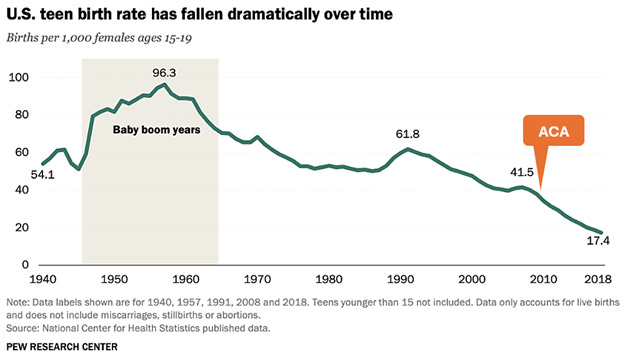
Teen pregnancies are always higher risk, and risk is always costly physically, emotionally, and economically. Adolescent moms face higher risks of severe complications than older women, and babies of adolescent mothers face higher risks of prematurity and all the severe, costly neonatal and childhood conditions related to that. Medical debt gets added on to her already overwhelming lifetime economic burden, and society pays for what the mother can’t.
Adolescents rarely recover economically from a teen pregnancy. Teen pregnancy and poverty are deeply intertwined. Schooling is halted, job opportunities are far more limited. We’ve known for two decades that these moms will have a significant reduction in income that lasts well into adulthood. Their kids are raised in poverty, with lowered economic horizons themselves. Early adulthood is when the groundwork for future economic wellbeing starts, and not being able to do so creates widening inequality, long term economic instability, and the mom’s ability to subsequently provide for their children. Which means you and I eventually will.
The ultimate effect is that many of these women and their children will be consigned to a lifetime of poverty. Anyone with any knowledge of health policy and public or women’s health knows this, definitely including the politicians on Congressional health committees.
There will be more programs like this quietly pulled. It’s so easy: just pull existing funding. No votes, little notice. Those who are against birth control will call it progress. My name for it is poverty promotion.
If you were a politician worried the falling US birth rate isn’t producing enough low wage workers, taking contraception away from economically at-risk women is a great place to start fixing it.
This year, it’s about a lot more than traditional religious beliefs
As they will with the budget and ACA renewal debates this summer, Republicans undoubtedly will claim the issue is costs, not women’s care per se, although they’ll obviously make backers on the religious right happy with decisions that limit birth control or abortion.
But there are very different undercurrents now about “women’s health”—really reproduction—with far more in play than conventional religious beliefs. Pronatalism2 is front and center and out in the open; it was outed by JD Vance’s “childless cat ladies” comment. If you’ve understandably had cognitive dissonance about the personal beliefs of Vance and Pete Hegseth, here’s a catch-up primer from center-right3 The Times in the UK. And if you’re not up to date on how deeply—and strangely—Silicon Valley tech bros are involved in pronatalism, women’s reproduction politics, and eugenics, this abruptly enlightening video from The Wall Street Journal is a must: Why Musk and Other Tech Execs Want as Many Babies as Possible.
Update Apr 17: The WSJ just published The Tactics Elon Musk Uses to Manage His ‘Legion’ of Babies—and Their Mothers—currently, at least 14 known children. His polygamy is screaming for a documentary—or a horror movie. (If you hit a paywall, try entering the URL for the WSJ article here: www.archive.ph.)
The tradwife ideology is all wound up in this as well; a “techno-Puritan”4 Peter Thiel-inspired tradwife is featured in the WSJ piece. Like that couple and Hannah Neeleman, “the queen of tradwives,” the top tradwife social media influencers who have millions of followers are independently wealthy. It’s not difficult to portray a romantic life in the woods when money isn’t an issue.
Within that odd but very real background, here are the other major themes that will play out this summer on the budget and ACA renewal under the rhetoric of saving costs, babies, and the American way of life.
Our birth rate is at a historic low, well below replacement level, and it’s still going down.
Low birth rates are always economically-rooted. Our politicians are affluent5 and older: while only 18% of the US population is 65+, it’s 50% of the Senate. Politicians either cannot, or will not, see the economic issues facing our childbearing-age populations, Millennials and now Gen Z. “Will not,” because they’d have to come to grips with the dramatic change in the US wealth gap6 since the impact of the trickle-down economic theory in the late 80s. The WSJ video does a great job of showing the implications of this on our economy and our lives; it is without question a disaster in the making that we are studiously avoiding dealing with.
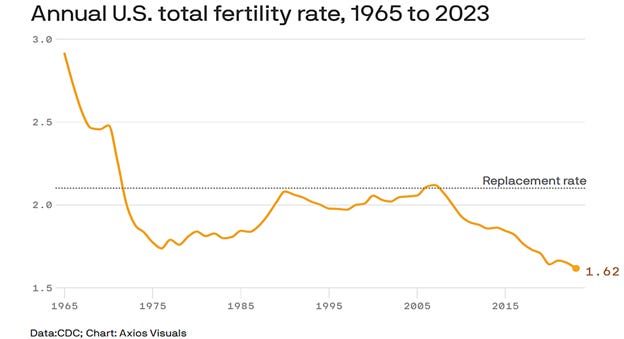
The Heritage Foundation writes “happy, hopeful people have babies,” warns about treating children and mothers like a means to an end, and notes that for many women, the answer to the falling birth rate is simple: “They need to trust that the losses and changes of parenthood they might fear will be worth it.”
In the US, we tend to look only at income as a measure of social success. For these families, it’s much more than that. Among peers nations, the US remains in the bottom five of 40 OECD countries in support of pregnancy and early parenting (see more here), and there’s been no sustained effort to address those issues. Bottom line: If you’re a Millennial or Gen Z, “happy and hopeful” is not your mindset on reproduction, whether it’s about the economy or ecology, something those generations also worry about far more than Boomers.
2024 was a wake-up call for employers and the military
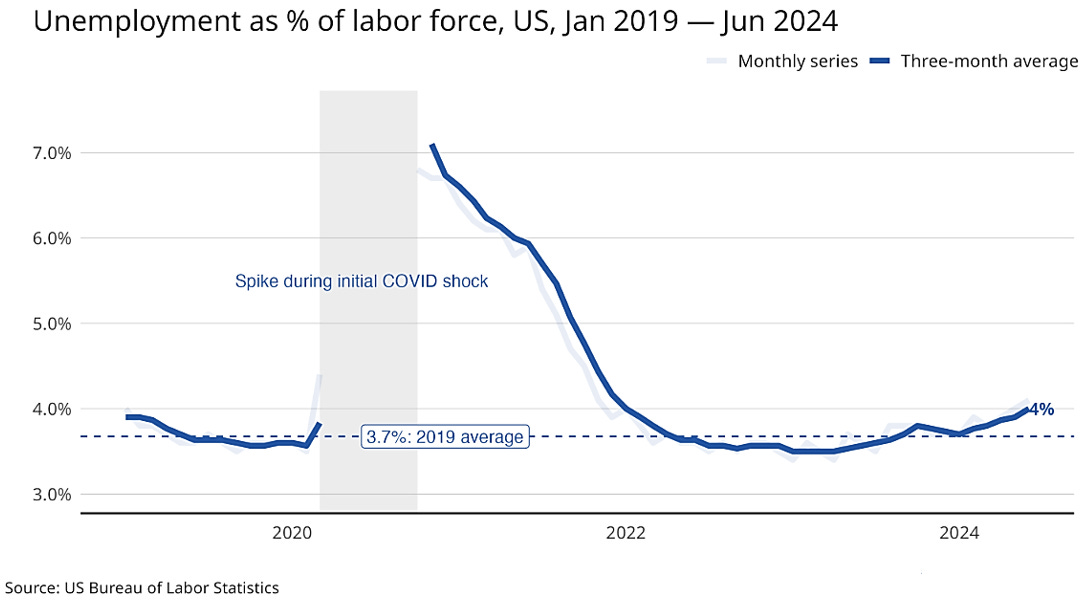
Particularly after the 2008 recession, birth rates really dropped. Since 2008, we’re missing at least 11 million kids who were never conceived. That became very real last year, when the oldest of those missing kids would have turned 16, eligible for military enrollment and employment, both of which were already in trouble with low military recruitment and historically low unemployment (~4%).
The unemployment rate is low nationally; workers are needed, and contraception is interfering
Despite all the rhetoric implying there are millions of workers who want jobs we no longer have, there just aren’t. Post-pandemic and pre-DOGE, the US unemployment rate was consistently at or below 4%.7 DOGE lay-offs have primarily impacted the DC area; other losses are spread out enough nationally that if the economy stays stable, the nationwide unemployment rate will likely continue low. The March 2025 (post-DOGE) national unemployment rate was 4.2%, and even a million deportations won’t affect the 170 million US job market one way or the other.
And if the economy is otherwise destabilized, resulting in higher unemployment, that’s sure not going to encourage young families to have more babies.
While the White House has been laying off droves of staff, those laid off are white collar and usually well-educated, often scientists. No matter how you feel about government employees/bureaucrats, they’re very unlikely to fill those million largely menial jobs immigrants won’t be doing anymore.
Historically, immigrants have always backfilled our birth rates—and our hardest jobs
Immigrants—who fill some of our lowest paying jobs—have always backfilled our birthrates. As the International Monetary Fund (IMF) notes, “Immigrants also support the demographics of advanced economies because their fertility rate is higher than that of natives. In the United States, the total fertility rate of natives was 1.76 children per woman in 2017, whereas that of immigrants was 2.18. The presence of immigrants helps to keep U.S. fertility at levels closer to the replacement rate.”
Neither party has addressed immigration in any strategic, rational way. We’ve gone from “What border?” to the current aggressive (and potentially illegal) removal. The White House goal is to deport a million immigrants in 2025. Immigrants most often work in construction, agriculture, maufacturing, and yard and home care. Research clearly indicates that “Americans generally agree that immigrants—whether undocumented or living legally in the country—mostly do not work in jobs that U.S. citizens want, with a majority saying so across racial and ethnic groups and among both political parties.”8
And then there’s the cost of the tax cut
The massive iceberg hidden under the surface is the cost of extending Trump’s tax cut—now understood to largely benefit the top 5% income bracket9—and funding more border security. That cost is somewhere between $0 (Sen. Lindsey Graham’s magic trick) and $4.6T, depending on which member of Congress is talking about it.
Everything that’s happened since January 20 is aimed head-on at this.
Last week’s Congressional budget plan clearly targets Medicaid, as expected despite myriad public denials. (Find more background here and here.) A clash on Medicaid10 and secondarily on the ACA renewal is inevitable. The best play for savings in the $1T range is through massive Medicaid cuts, and the House was happy to home in on that early. The Senate is more reluctant, and there are squeamish members of the House as well. The most serious impact of Medicaid cuts will be on rural communities—reliably Republican voters. The billions of of dollars in required cuts would target 11% of Medicaid recipients and negatively impact the hospitals and physicians who provide rural care. More than a third of US counties are already ‘healthcare deserts’ with no hospitals, and rural residents are keenly aware of the issue.
No party that targeted healthcare coverage has gone unscathed in the following elections, a key reason most Republicans gave up on eliminating the ACA. Both Medicaid and the ACA pay for well-woman care, including birth control. The ACA forced employers to do that, one of the many reasons conservatives didn’t like the ACA. There are plenty in Congress who have been waiting to gut Medicaid for years, and then there are the fiscal hawks in the House who have no difficulty manipulating the Speaker’s very, very thin margin. Even with their reluctant support, the budget bill only passed in the House by two votes last week.
All in all, we’re set for head-spinning rhetoric and mystifying motivations
The new budget agreement calls for $1.5T in cost cuts—kind of. While everyone knows that means Medicaid, and the $1.5T wasn’t written specifically into the bill, the Senate was forced to “promise” they’d do that to get the fiscal hawks to come along. DOGE is now saying they’ll get maybe $150 billion in savings, after promising $2T, but economists are warning that between reports of lost tax income, the cost of putting workers on administrative leave, and DOGE’s own operational budget, the Elon Musk fronted unit may wind up costing more than it saves. All that does it put more pressure on massive budget cuts to pay for the tax cut.
Rest up. Unfortunately, we haven’t seen anything yet.
Eve forced Adam to eat the apple; not his fault what happened.
Pronatalism is an attitude or policy that favors or encourages population growth, particularly by supporting a higher birth rate. It can involve government incentives, societal pressure, or other measures aimed at increasing the number of children born.
The pronatalism ideology is firmly rooted in conservative politics. For that reason, we have purposely including right-leaning commentary and opinion on the ideology: if they’re concerned about it, anyone on the left should pay attention. The Times (UK) is rated center-right. WSJ news is rated center; WSJ opinion is rated right. The Heritage Foundation published Project 2025; there’s little question about where they lie.
Honest. There’s no way to make this up.
Sen. Rick Scott (R, FL) is the richest member of Congress. Our low tolerance for old news is his best friend. Much of that came from his tenure as CEO of Columbia/HCA, where he led a defrauding of Medicare, Medicaid and other Federal programs that resulted in 14 indictments and what was then the largest healthcare fraud settlement in US history. Can’t beat that for senatorial (and almost presidential) qualifications.
On this image of the wealth gap, note the relative loss in percent of US wealth by those below the 50th percent compared to those above since the early 90s. Below the 50th will include the vast majority of our young childbearing-age populations. Above the 50th are those who have gained on percentage of US wealth. Particularly pay attention to what happened in the top 1% and 0.1% around 2020 after Trump’s tax cut took effect. And here’s where we rank on our wealth gap compared to other countries: 6th worst out of 29 countries.
US Unemployment rate
Our gardener put it succinctly “Ain’t no white boy gonna be pulling up those weeds.”
In 2025, to be in the top 5% that gets 45% of the tax cut benefit, you’d have to earn at least $360K. The other 95% split the rest. I find myself humming, “Don’t cry for me, Argentina.”
Medicare could also get pulled into cost-cutting, but politically that’s unlikely. Poor people on Medicaid make an easier target than taking on the AARP and Boomer political donors.
I'm caught up! Really great job on this article! I'm glad I waited to read it when I could take my time with it.
I laugh though at social media influencers who call themselves "trad wives." If you bring in income for your family, you're not a traditional wife you're just a regular wife. College degree? Driver's license? Credit card? Ability to vote? Assets in your name? Yup, just a regular wife.
Glad I caught this on Notes first (it’s in my inbox waiting to be read), great image!