

Will private investment save women's health research and care?
Exactly when the Feds are slashing medical research funding, these private companies are stepping up. As women we need to know who’s helping us--so we can help them.

Click to skip to (the other) Maryann’s terrific article, The Autoimmune Gender Gap: 10 Private Companies Advancing Women’s Health. Here’s her Substack page, and here’s more about her and why she does this. I’m a fan.
Autoimmune diseases disproportionately impact women’s lives, bodies and brains. Below, we’ve included the top (worst) 10 for women and info links for each, and a gifted article on the impact of NIH pulling the rug out from under existing research, affecting 300,000 scientists and—very directly—our health prospects.
We were ripping right along. And then…skid!
US medical research historically excluded female participants. Research was done on men and generalized to women—the “women are just littler men” theory. You may have experienced how well that’s worked on everything from office desk chairs to smart phone size to stretching your arms to get to the car steering wheel. Glass staircases are particularly special. [Here are 18 more.]
In the past twenty years, there’s been a race to catch up on women’s health research, but even today, only a third of medical research studies include women. The result is that we know a whole lot more about men’s diseases, and far less than we should about diseases more often experienced by women, like autoimmune disorders, for which women are at greater risk than men.
But since 2020, things had really started to change in our favor with research designed specifically on diseases women experience more or differently than men, and a federal call for more research specific to women. And then…the election.
Now the National Science Foundation, the National Institutes of Health and other science agencies are scrambling to comply with administration orders to eliminate federal support for diversity, equity and inclusion efforts, with words like “female,” “woman,” and “male-dominated” removed from grant proposals on gender preference grounds. Cuts are shutting down studies on Alzheimer’s care, uterine fibroids and pregnancy risks because they focus on the impact on women.
“In just six weeks, the Trump administration overturned NIH’s leadership, slowed its main mission of identifying the best new science to fund, and silenced personnel at the biggest sponsor of biomedical research in the world—a nearly $48 billion enterprise that supports the work of some 300,000 external scientists.” [Click for GIFTED article]
The young gun tech bros of DOGE weren’t hired to be discerning about how those words are used or understood, and—as has been happening elsewhere—there are hints some revisions to the revisions may be coming. But just yesterday, the administration cancelled hundreds of millions more in grants already in process for being “inconsistent with department priorities,” leaning on a change made late in the last Trump administration in an early January OMB regulation no one noticed at the time in the onslaught of the pandemic.
Now, more than ever, if we’re to ramp up research on diseases experienced disproportionately by women, private biotech and health tech startups are likely the answer
Autoimmune diseases are predominantly women’s issues: 4 out of 5 autoimmune cases are in women, which meant that, for a long time, the debilitation and pain were just “in our heads.” Now we at least know it’s not all in our heads; in fact, these diseases can have a deadly effect on multiple organis in our bodies.
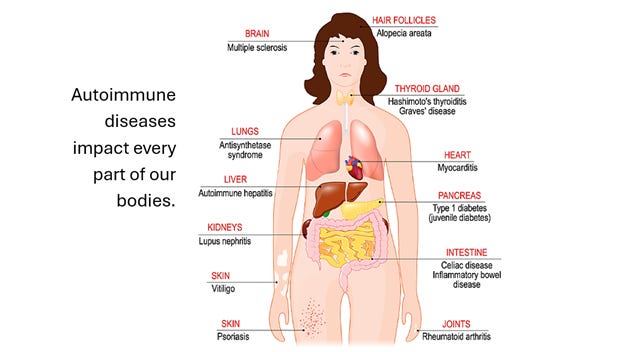
The top 10 autoimmune diseases disproportinately affecting women are rheumatoid arthritis, lupus (SLE), multiple sclerosis, Sjögren's syndrome, scleroderma, thyroid diseases (Hashimoto's thyroiditis, Graves' disease), inflammatory bowel disease (IBD), psoriasis, psoriatic arthritis, and type 1 diabetes (T1D), which can really impact our reproductive systems.
Right now, healthcare predominantly just tries to suppress these diseases. What we don’t know is immense, from how to screen effectively, how to prevent or slow the disease process, and how to treat them more successfully, or even cure them.
The good news—I guess—is that we lost so much time studying them that we’re about to leap from old 20th century research processes right into precision medicine from biotech on many of these problems. Studies like Genes for Good at University of Michigan are combining hundreds of thousands of anonymized DNA data files to solve diseases like we’ve never been able to before.
But U of M’s research is likely at least partly funded by NIH, and could be pulled anytime. Private companies don’t have that problem. Autoimmune diseases are a $50B+ market, and women now have their own money1, thanks to Boomers who broke the glass ceiling. To riff on the UBS wealth info, we have always had the purpose; now we also have the parity and the power, as consumers and investors ourselves. And private equity noticed.
Click for another great post from Maryann (FemmeHealth Ventures), The Autoimmune Gender Gap: 10 Private Companies Advancing Women’s Health. She lists companies taking up the reigns on these historically understudied diseases, targeting women-specific autoimmune conditions with precision medicine. They’re attracting major private funding from top biotech investors and VCs, and likely providing future investment opportunities for women to help women. Stay tuned…these are exciting times!
You may need to sign up for a free Adobe account to the read the article on women’s wealth from UBS. It’s worth it. UBS, Union Bank of Switzerland, is a global financial services company headquartered in Zurich, Switzerland, known for its wealth management, asset management, and investment banking services.