


(OK, this is kind of geeky…but what’s happening on the Internet is a real-time vote on societal thinking elsewhere, too, so bear with me here. This could be the real game changer in women’s health, at a time there isn’t much to be excited about from DC. For women, the family CMO—Chief Medical Officer—it holds terrific promise.)
When I was working in Japan—where I was treated very well—I spoke with the wonderful Japanese gentleman who sponsored me there about his philosophy, and Japan’s, about women in the work force. His reply was that he wanted to make sure he worked with the best of 100% of the population, not just the best of 50%. This story is about whether social media sites want to attract only a portion of the population, or the whole population, and how that may be changing.
Most social media sites skew young and male; after all, now gray-haired mostly-male tech bros invented the Internet when they were their generation’s young guns. I count only 12 women in this l.o.n.g. list of over 60 Internet Pioneers; the only surprise is there were even that many. It wasn’t exactly a woman’s field back in the 60s: nursing and education were the usual routes. And until search engines made the Internet more generally useful in the late 1990s, it was mostly a male playground. (Dungeons and Dragons, anyone?)
But when search engines made the Internet useful, women caught up pretty quickly. Specifically, they did what we women do—search for information, particularly health information. When it comes to seeking health information, women’s Internet use continues to dominate men’s.
Like other sites that skew male, if you’ve ever been on Reddit, it’s not difficult to figure out the site’s daily users are overwhelmingly male (64%) with an average age of 23. Other sites, like Facebook, pull in an older demographics, and some sites—notably Pinterest—cater more to women.
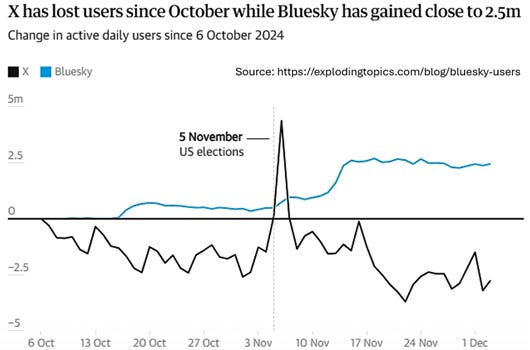
As the current heat around TikTok demonstrates, competition among social media sites is intense. These days, social media share trends are reported in more detail than communicable diseases. Intense competition brings a new view to strategy and often market share shifts. One of the best-watched current examples is the rapid abandonment of X/Twitter by tens of millions of users who largely went to Bluesky (BSKY). Bluesky tripled its daily users since the election; that growth is being watched and reported almost daily, because the media understand that—like Tesla sales—it’s a real-time vote on Elon Musk and DOGE. [Note the graphic below demonstrates changes in use—not numbers of users; X is still much larger (250 M daily users, 61% male) than Bluesky (33 M, and even more male at 70%).]
So what’s going on at Reddit?
Globally, social media users are still predominantly male (54%). But given Reddit’s reputation as even more male (64%) than that, news this month there was intriguing.
Working with the Weber Shandwick ‘Women’s Health Center of Excellence,’ Reddit is reporting a 37% site increase on discussions on women’s health in one year. Sex topics and men on the Internet have always been linked, so you’d have to at least consider the increase is from women. Menopause is usually not a hot topic for men.
Clearly the female leaders of Weber Shandwick’s Women’s Health Center of Excellence are focused on driving women’s market share at Reddit—and they’ve walked the walk. Donna Klassen is the Co-Founder and CEO of Let's Talk Menopause, and Dr. Lisa Larkin is Founder and CEO of Ms. Medicine, a national concierge network of women’s health providers. Click here for their synopsis of what they’re doing at Reddit to drive the change; it’s right on target for what other data has long said about women’s health needs.
How big is the opportunity?
This is where what Reddit is doing syncs with trends Maryann Selfe of FemmeHealth Ventures talks about and that we’ve also written about. Now more than ever, women are no longer limited geographically on finding health information or, critically, linking up with other women experiencing the same issues, even very rare conditions. For better and sometimes worse, the Internet opens everything up and is a leading force in democratizing medicine and healthcare. And women are the ones driving that as we seek information when something just isn’t clicking.
So, if Reddit—with its very young male user base—is turning strategically to attracting women in a highly competitive market, it’s likely other social media sites have noticed, or soon will.
Precisely because the average Reddit user is a 23 YO male, a strategy to engage women is a huge opportunity to expand the user base. And Reddit already has a community approach (subreddits), a strength as they add women’s health. Substack’s users are also predominantly male—essentially the same as Reddit at 63%—and strongest in the Millennial 25-44 age range. And out of almost 30 interest categories new Substack subscribers are invited to list, there is no “women’s health.” Yet. But Substack does have another strength for women, and it’s why Women Unbroken is on Substack. They’re focused on independent writers providing curated content, ideal for smart women seeking information they can use. Substack’s demographics also indicate a higher education level, not surprising given the draw of in-depth content—and there are some very smart writers on Substack, often highly recognizable names.
We know women use the Internet more than men to seek health information. That’s been the case so long—since way back in the early 2000s—that it’s assumed, although few strategists thought to turn the data around and use healthcare information to attract women users.
What’s more recent is the age spread in Internet users. Even back in the 2022 data below, more than a third of 75+ adults were using the Internet for health or medical information.1 Any social media site searching for population expansion opportunities would see this data. And they’d have to be pretty strategically naive to assume they could attract Boomer and Silent Generation women (~ages 61 to 80+) the same way they now attract 30 YO men. Visually, for instance, market research shows statistically significant differences in what attracts men or women to a site. (If you’re thinking the same thing I am, you’re smiling, too.) Content is also very different: the detail that women want is often quickly labeled TMI for men. The Internet is perfect for that—keep the site clean, but provide deep links for further information for women seeking it.
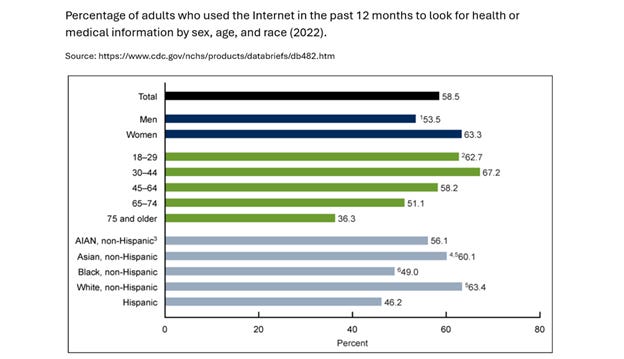
Just eyeballing the 2022 data, it’s a pretty simply conclusion that the highly-saturated young male market was probably less than a third of the potential social media opportunity then, and likely even less now as older gens are more familiar with, and likely to use, the Internet. With Reddit doing press releases on their new female market penetration, we’ll see which sites consider the issue—which will figure out women seek information differently than men, versus the ones who keep doing the same thing that that already isn’t bringing women in, particularly Gen X, Boomer and Silent Generation women.
Social media sites are obviously good at attracting the young male market. What they generally don’t realize is that’s a default position, not a marketing strategy. Historically, websites were largely designed by men, and men intuitively know what appeals to men, just like women intuitively understand much of what appeals to women.
From market research, we’ve know for two decades that men are drawn to websites designed by men, and women are drawn to sites designed by women. That has to do with images, colors, shapes and far more subtle, sometimes surprising, design elements—like men prefer profile images of people, not full face, and women prefer images looking right at them…eye-to-eye contact.2 Particularly when the largely-technical groundwork for today’s sites was developed, men were the designers. Even today, 57% of web designers are men.
One of the first decisions a company has to make to attract new markets is to move site design from what ‘feels right’ to designers to what data-based design research says will attract a new population. Moving from the hit-and-miss intuitive ‘feels right’ to data-based design is a critical tactic to support stratetgy. Objective design research on gender has been around for years; I included it in my own book on marketing women’s healthcare a decade ago. Researchers like Gloria Moss, PhD, have written extensively on gender-based marketing design in both professional books and articles and in her less statistically-saturated everyday version.
Women’s attention is attracted differently than men’s. It’s really pretty simple stuff if a site is into strategy, not an intuitively comfortable default. It’s just data that widens the market opportunity. It doesn’t make marketing to men wrong, although I’m sure we’ll hear complaints from someone somewhere about the feminization of the Internet the minute more circles (preferred by women) appear than squares (preferred by men). It’s just different than what’s been done in the past, and Moss’ data clearly demonstrates that what appeals to women also appeals to men when not overdone like the girls’ toy aisles. (Note the reverse is not true—what appeals to men in site design is less likely to appeal to women.)
So…back to the opportunity.
As noted before, what happens on the Internet is a type of real time, instant vote about where society is today, like the six-month user change data in X/Twitter and Bluesky. The 37% increase in one year at Reddit in women’s health use is another.
This week, Amboy Street Ventures, a venture firm that invests in women’s health and sexual wellness, published a report on “ghost markets” in the US, defining ghost markets as markets where solutions are still emerging and competition doesn’t yet exists, a phrase that makes any marketing professional salivate. Amboy identified a $360 billion opportunity in the U.S. Or, as Fortune’s headline this week put it, “Women’s health and sexual wellness are a $360 billion opportunity in the U.S. alone, a new report finds.” Find the Fortune report here (or maybe here). And Silicone Valley banks just this week reported record venture capital investment in women’s health start-ups.
Whether or not DC or the world has noticed, it feels like the market opportunity may finally be driving women health research and care options online now. If it is, the market opportunity for greatly expanded information and access for women may be closer than ever before. Stay tuned, and reward those who turn the tide.
The increased use among older adults is likely a side effect of the pandemic, when many had no choice but to use telehealth for management of chronic diseases. A big leap at the time for older generations who didn’t ‘grow up’ with digital communication at work, health systems (eventually) made it relatively easy, opening the door to greatly expanded use of the Internet.
This is why many men love a good bar—sitting side by side, not directly facing the other person. Check it out yourself: sit at the bar, and see who turns to face another person face-to-face, versus talking while watching the bartender or TV. Again, nothing wrong with either; just know what invitation is being sent.
I've been considering starting an account on Reddit but when I last looked it was predominantly young male and it definitely felt that way. I do best on social media when I can interact and engage with other members... Threads 👍 vs. IG 👎. What do you think? Should I jump in and try it? I haven't had much luck with Bluesky as that seems to be more politically focused, I like being a reader though.
super interesting. i appreciate the sex-aggregated breakdown of social media platforms. also, now that i know that most of social media is content made for and by 23 year old white males, i'll definitely be spending more of my time in reality from now on!